
21 October 2026
PTFE vs UHMWPE: Engineering Plastic Comparison Guide
When choosing high performance engineering plastics for mechanical, chemical, or sliding applications, the debate often comes down to ptfe vs uhmwpe. Both materials are renowned for their low friction properties, outstanding slickness, and non-stick performance. However, they serve very different operational environments. Selecting the wrong material can lead to premature component failure or unnecessary expense. In this guide, we break down their structural properties, wear characteristics, thermal ratings, and practical applications to help you choose the ideal plastic for your project.
Understanding the Core Chemistry of PTFE and UHMWPE
To understand how each plastic performs under stress, it helps to examine their basic composition. PTFE, often recognised by the commercial brand name Teflon, is a fluoropolymer composed of carbon and fluorine atoms. This molecular bond is one of the strongest in organic chemistry. As a result, PTFE exhibits extraordinary resistance to corrosive chemicals, weather degradation, and extreme operational temperatures.
UHMWPE, or Ultra High Molecular Weight Polyethylene, is a specialised grade of polyethylene featuring extremely long polymer chains. These long chains transfer mechanical loads effectively through the polymer backbone. Because of this structure, UHMWPE provides class leading impact strength, puncture resistance, and sliding wear resistance. While PTFE excels under severe thermal and chemical conditions, UHMWPE is the superior choice when your primary challenge is brutal abrasive wear or physical impact.
Wear Resistance and Friction: How They Compare
Friction and wear are two distinct mechanical properties that engineers often evaluate together. Both plastics offer very low coefficients of friction, but their wear longevity under abrasive contact varies considerably.
PTFE delivers an exceptionally low dynamic coefficient of friction, often measured between 0.05 and 0.10. It is so slick that virtually nothing sticks to it, which makes it ideal for non-lubricated dry sliding bushings, valve seats, and release liners. However, pure or virgin PTFE has relatively low mechanical strength. Under heavy, continuous loads or high speed motion, virgin PTFE can experience deformation or creep, commonly known as cold flow. While adding fillers such as glass, carbon, or bronze can improve mechanical stiffness, unfilled PTFE remains relatively soft against abrasive particles.
UHMWPE, on the other hand, possesses a slightly higher friction coefficient (typically 0.10 to 0.20), but it outperforms almost every other industrial plastic in abrasive wear resistance. In fact, UHMWPE regularly outlasts carbon steel in slurry, gravel, and high abrasion bulk handling environments. If your components face constant contact with moving aggregate, conveyor chains, or sliding metal parts, UHMWPE will resist grooving and mechanical erosion far better than PTFE.
Temperature Limits and Chemical Compatibility
Thermal stability is one of the clearest dividing lines in the ptfe vs uhmwpe selection process. Operating temperatures often eliminate one material immediately.
PTFE handles continuous operating temperatures from minus 200 degrees Celsius up to 260 degrees Celsius. It can even withstand brief spikes up to 300 degrees Celsius without melting or decomposing. Combined with almost complete chemical inertness across the entire pH scale from 0 to 14, PTFE is the premier solution for aggressive acids, volatile solvents, autoclaves, and high temperature processing lines.
UHMWPE has a much lower thermal ceiling. Its continuous service temperature ranges from minus 150 degrees Celsius up to approximately 80 degrees Celsius. Above 90 degrees Celsius, UHMWPE softens rapidly, losing structural rigidity and wear resistance. However, it delivers excellent cryogenic impact strength, remaining ductile down to extremely low temperatures where materials like acetal or nylon might turn brittle. In terms of chemical resistance, UHMWPE resists most strong alkalis, dilute acids, and cleaning chemicals, but it can degrade when exposed to strong oxidising agents and aromatic hydrocarbons.
Technical Property Comparison Table
Here is a direct look at the mechanical, thermal, and physical metrics of virgin PTFE compared to standard natural UHMWPE sheet and rod:
| Property | PTFE (Virgin) | UHMWPE (Virgin) |
|---|---|---|
| Density (g/cm³) | 2.15 to 2.20 | 0.93 to 0.95 |
| Continuous Service Temp (°C) | -200 to +260 | -150 to +80 |
| Coefficient of Friction (Dynamic) | 0.05 to 0.10 | 0.10 to 0.20 |
| Tensile Strength (MPa) | 20 to 35 | 20 to 40 |
| Abrasion Resistance | Moderate (susceptible to creep) | Exceptional (outwears steel) |
| Chemical Resistance | Universal (pH 0 to 14) | High (susceptible to strong oxidisers) |
| Moisture Absorption (%) | Less than 0.01 | Less than 0.01 |
| Relative Cost | Higher | Moderate |
Machining and Fabrication Considerations
Both materials are readily available in rod, tube, and sheet forms. However, their physical softness and low surface energy require specific tooling approaches during plastic fabrication.
Because both materials have non-polar surfaces, neither can be glued or solvent welded effectively without specialised chemical etching. Mechanical fastening, press fitting, and retained housings are the standard installation methods. PTFE can be skived or compression moulded, but precision parts are produced through specialised engineering machining.
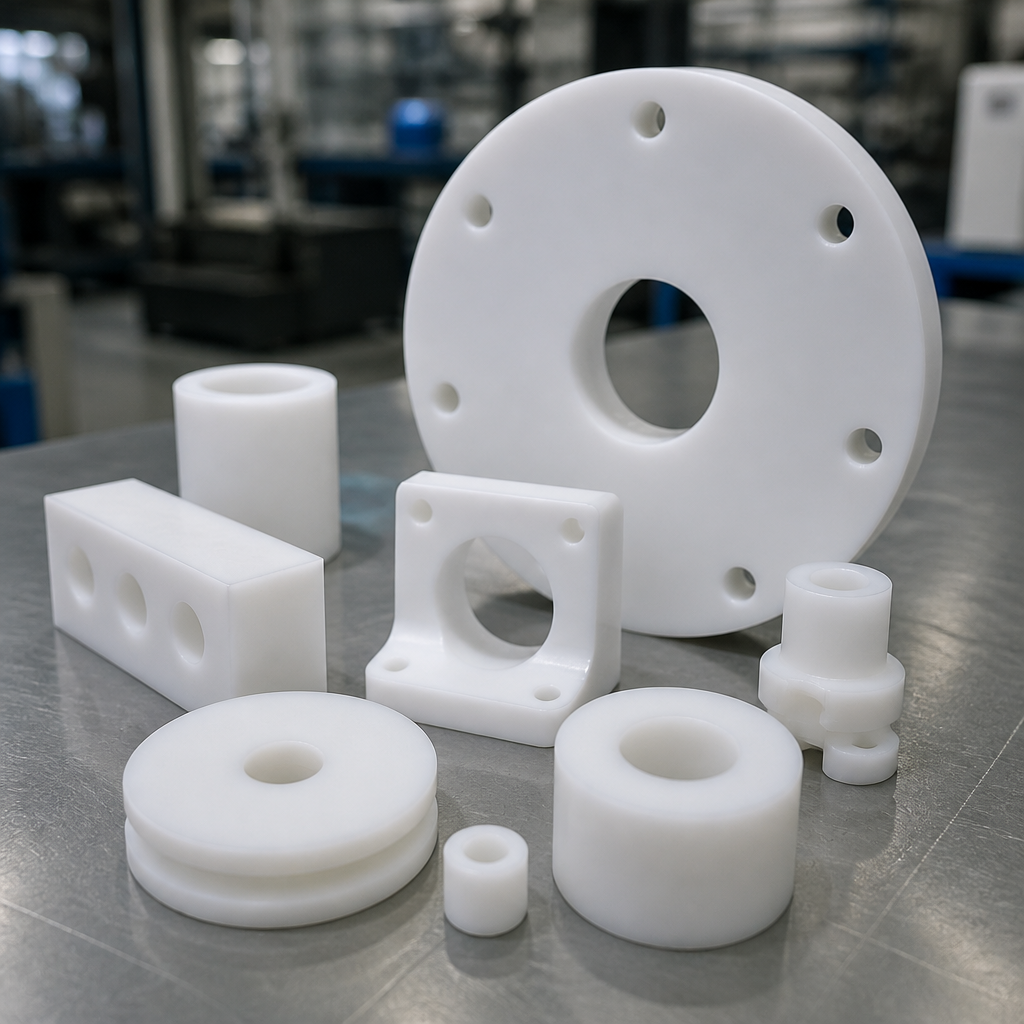
When cutting flat wear strips, chute liners, or chain guides, our workshop uses precision CNC router cutting with sharp, high clearance tooling to prevent material heating and edge burrs. For round bushings, seals, and custom sleeves, CNC lathe machining requires sharp rake angles and high feed rates. This prevents UHMWPE from stringing around the tool holder and stops PTFE from creeping away from tool pressure.
Both plastics can be ordered cut to size in standard sheet thicknesses from 3mm up to 50mm, or in round rod diameters ranging from 10mm to 200mm, ensuring minimal material waste for your machining runs.
Common Applications: Making the Right Choice
To help you decide between PTFE and UHMWPE, consider these typical industry use cases:
- Choose PTFE for: High temperature valve seats, chemical pipe gaskets, non-stick bakery release plates, electrical insulators in harsh environments, and low speed dry bearings operating above 100 degrees Celsius.
- Choose UHMWPE for: Bulk material handling chute liners, conveyor wear strips, hopper guides, marine fender pads, timber mill wear tracks, and food packaging line star wheels operating at ambient factory temperatures.
Caring for both materials is straightforward. Clean them with mild industrial detergents or water. Avoid abrasive metal scouring pads on PTFE if you want to maintain its low friction face. For UHMWPE, protect outdoor installations from prolonged direct solar exposure by selecting UV stabilised black grades rather than standard virgin white.
Source High Performance Engineering Plastics from Holland Plastics
Whether your application requires the extreme heat resilience of PTFE or the heavy duty abrasive endurance of UHMWPE, Holland Plastics stocks and machines premium engineering plastics for industrial and commercial projects across Queensland and Australia. Contact our technical team today to discuss your exact dimensions and operating conditions, or simply request a quote online for quick pricing on sheets, rods, and custom machined components.