
Any plastic. Any size. At your door.Shop Now →
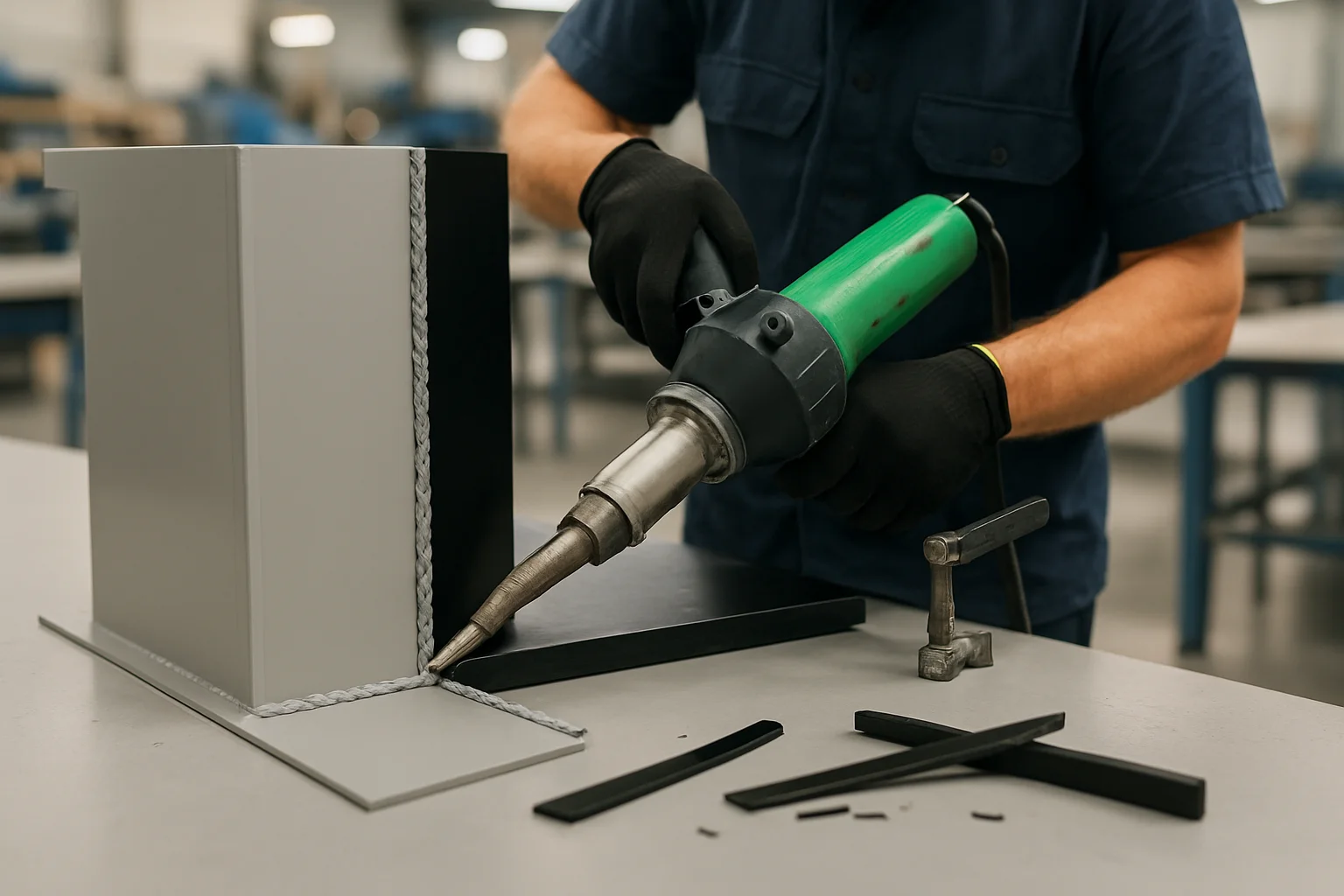
Hot-air plastic welding a polypropylene tank seam in the Holland Plastics workshop
Services

Plastic Welding

±0.1mm

Precision Tolerance

35+ Years

On The Gold Coast

Full Range

Perspex, HDPE & More

Australia-Wide

Fast Delivery

At Holland Plastics, we provide plastic welding on the Gold Coast from our workshop in Molendinar, building and repairing welded polypropylene, HDPE and PVC parts for industrial, commercial and agricultural customers. Plastic welding joins thermoplastic sheet, rod and pipe by heating the parent material and a matching filler until they fuse into one continuous piece. Done well, the welded seam becomes part of the structure rather than a separate joint held together by glue or fasteners.

We weld custom tanks, sumps, bunds, drip trays, ducting and chemical containment to your drawings or dimensions, and we repair cracked plastic tanks and parts that would otherwise need replacing. Every job is quoted individually and delivered across Australia.

Quick Facts

  • ✓ Over 35 years experience
  • ✓ No minimum order
  • ✓ Fast turnaround
  • ✓ Australia-wide delivery
Get A Free Quote (07) 5564 6744

Hot-Air and Extrusion Welding

We use two main welding methods, chosen to suit the material thickness, the joint and the job.

Hot-air (hand) welding: a hand-held welder blows heated air through a shaped nozzle, softening a filler rod and the edges of the sheet so they fuse together. It suits fillet and corner welds, smaller fabrications, fittings and repairs.
Extrusion welding: a hand-held extruder melts filler material and lays a continuous bead into a pre-heated joint. It deposits more material in a single pass, so it is used on thicker sheet and larger structures such as tanks and bunds.

Materials We Weld

Plastic welding only works between compatible thermoplastics, so we weld like to like: polypropylene to polypropylene, HDPE to HDPE and PVC to PVC, using a filler rod of the same material.

Polypropylene (PP): our most common welding material, widely used for chemical tanks, plating lines and process equipment.
HDPE: tough and impact resistant, used for water tanks, liners, food-industry parts and marine fabrication.
PVC: rigid with good resistance to many acids, used for ducting, fume extraction and chemical tanks.
PVDF: a high-performance fluoropolymer for more aggressive chemicals and higher temperatures, welded where the application calls for it.

What We Make

Custom tanks for water, chemicals and process liquids
Sumps, pits and collection tanks
Bunds and secondary containment
Drip trays and spill trays
Ducting, hoods and fume extraction components
Chemical containment for plating, laboratories and industrial plants
Repairs to cracked plastic tanks and parts, plus added fittings, outlets and modifications

Why Choose Welded Plastic

Chemical Resistance

Polypropylene, HDPE, PVC and PVDF each resist a wide range of acids, alkalis and other chemicals. We help you match the material to the chemical, concentration and temperature.

No Corrosion

Plastic does not rust or corrode the way steel does, so welded plastic suits wet, outdoor, marine and chemical environments.

Seamless and Watertight

A properly welded seam fuses the material together, giving a continuous, watertight joint without gaskets, sealants or fasteners.

How to Get a Quote

Send us your drawings, or the dimensions of what you need, along with the material if you know it. For tanks and containment, tell us what the item will hold, including the chemical, concentration and operating temperature, so we can recommend a suitable material and wall thickness. For repairs, send clear photos of the damage and the item's dimensions. We will review the details and come back to you with a quote.

Service Area

All welding is carried out at our Gold Coast workshop at 13 Distribution Avenue, Molendinar. Local customers are welcome to drop off items for repair by arrangement, and we deliver finished work across Australia, including Brisbane, Sydney, Melbourne, Adelaide, Perth and regional centres.

Plastic Welding FAQs

Can you weld polypropylene to HDPE?+
No. Polypropylene and HDPE are different plastics and do not fuse into a reliable weld. Plastic welding only works between like-to-like materials, so we weld polypropylene to polypropylene, HDPE to HDPE and PVC to PVC, using a filler rod of the same material.
Can you repair a cracked plastic tank?+
Often, yes. Cracked polypropylene, HDPE and PVC tanks can usually be repaired by welding, provided the material is identified correctly and the surrounding plastic is in sound condition. Send us photos and dimensions and we will advise whether a repair is practical or whether replacement is the better option. Some tank types, such as fibreglass, cannot be repaired by plastic welding.
How strong is a plastic weld?+
A well-made weld in a compatible material can be strong, but it is generally not as strong as the unwelded parent sheet. Weld strength depends on the material, joint design, technique and preparation, so we design welded parts with this in mind and use extrusion welding where joints need more material.
What thickness can you weld?+
We weld a wide range of sheet thicknesses. Hot-air welding suits thinner sheet and smaller parts, while extrusion welding is used for thicker sheet and larger structures. Send us your drawing or the thickness you have in mind and we will confirm what is suitable for your job.
Do you weld on site?+
Our welding is done in our Gold Coast workshop, where we have the equipment and controlled conditions to produce consistent welds. Please contact us to discuss your job and the options for getting the item to our workshop.
Free Quote

Get a Quote on Plastic Welding

Send us your specs, drawings or rough idea — our Gold Coast workshop will reply within one business day.

Click to attach files or drag & drop

Ready to Get Started?

Get a free, no-obligation quote on Plastic Welding from single pieces to full production runs.

Need Plastics Cut to Size?

Get an instant quote or use our online price calculator